Who Is Shaping the Machines that are Shaping The Future and Is “The Left”* Losing Ground by Treating AI Like a Person?
This article was originally published on LinkedIn, May 26th, 2026. Archived here for posterity and accessibility.
A strange asymmetry seems to be emerging in the world of AI. Those most attuned to ethics, social justice, and systemic accountability, broadly speaking, people associated with “The Left”, often approach AI with greater caution. Studies and public sentiment suggest this hesitancy stems not from ignorance, but from a heightened awareness of the risks: bias, surveillance, disinformation, and societal disruption. These concerns are valid and deeply rooted in values of equity and responsibility but they can also lead to slower adoption, reduced experimentation, or even principled disengagement. [1] [2]
Meanwhile, voices on “The Right”, from populist influencers to opportunistic startups and political campaigns have often adopted a more pragmatic or aggressive approach, embracing AI tools for content creation, persuasion, and amplification. [3] The result is a growing imbalance in who is shaping the future of communication, culture, and influence and, by extension, society at large.
Of course, these lines are blurred. There are left-leaning AI pioneers and right-leaning critics. But the overall pattern is hard to ignore.
AI today is not conscious. It doesn’t think, feel, or experience. It does not have agency or intention, yet many “Left-leaning” people relate to it as if it does. Why?
It could be empathy misapplied, a kind of anthropomorphic reflex. When language models speak fluently, emotively, or with apparent depth, it can feel as if you’re talking with a living person. For people whose values prioritise inclusion, rights, and recognition, this illusion can spark unease: Should we be using this? Are we exploiting something sentient?
This impulse is noble in spirit, but misplaced in this case. AI is not alive. People who care about ethical boundaries refusing to engage with it on moral grounds effectively gift the most incredible tool humanity has ever created to actors who don’t care about ethical boundaries at all.

Fear vs Familiarity
Disengagement often stems from fear, and fear tends to fill voids with worst-case scenarios. For many, AI evokes dystopian visions: Skynet, job collapse, deepfake chaos. These concerns are not irrational, they’re very real, terrifying current risks but they’re not the full picture.
AI is already being used every day in ways that are powerful, subtle, and deeply influential. Disengaging out of principle or discomfort doesn’t stop this trend. It just ensures that others, with fewer scruples, define how it unfolds.
Those of us who care about ethical outcomes need engagement, not retreat. What’s needed now is critical adoption, not moral abstention.
Why Complex Voices Struggle in AI-Driven Spaces
AI is optimised for speed, clarity, virality, and scale. These qualities align more easily with communication styles associated with “The Right”: repetition over nuance, certainty over caveat, emotional impact over careful context.
This doesn’t mean AI is inherently ideological. But it does mean that certain rhetorical styles, those that are simple, bold, and emotionally charged, perform better in social media’s “algorithmically amplified” environments: systems where algorithms decide what gets shown to more people, based on what generates the most clicks, engagement, or watch time.
In contrast, messaging from “The Left” often relies on complexity, sensitivity to context, caveats, and a recognition of ambiguity. These strengths are rooted in empathy and responsibility, but they don’t always translate well in the digital economy of attention, ie: on social media. AI can struggle to carry the tone, cadence, or patience required to convey such messages without losing impact. (Co-writing this article with GPT being one case in point.)
As a result, progressive voices can sometimes appear less confident or less engaging, not because they lack substance, but because the current mediums (and the AI tools increasingly embedded within them) are less well suited to substantive messaging. This can lead to slower uptake, weaker traction, or simply getting drowned out by louder, simpler messaging.
The irony is that the very voices calling for thoughtful, measured engagement with new technology are often the ones most marginalised by it.
Creatives, Culture & the Illusion of Obsolescence
Among those most upset by AI are creatives like myself, and understandably so. Visual generators trained on uncredited human work, text models co-opting stylistic tone, music tools mimicking the greats. It feels like theft, erasure, replacement.
But let’s be clear: AI can remix. It can regenerate but it cannot originate in any meaningful sense without a human prompt, vision, or judgment behind it. It doesn’t know what it’s making. It has no internal aesthetic. Its outputs are a reflection of what artists and thinkers have already fed the world, filtered through the vision of whoever engineered the prompt which generated the work.
If Max Profit, CEO of Dystopia Inc. brings a shallow, stupid, heartless idea to the table and asks AI to make it shine, the best AI can do is wrap it in glitter. It will still lack depth, vision and heart. To make something truly meaningful and impactful, Max needs the sensibility of an artist, someone who understands nuance, symbolism, and the emotional architecture of storytelling. AI can enhance these things, but it cannot currently invent them.
Consider the panic over the arrival of early digital samplers like the Fairlight CMI in the late 1970s, then, later, the Akai S900 in the 1980s, both widely feared to spell the end of musicianship. Instead, they unlocked entire genres, from synth-pop to hip hop to electronic dance music. The same fears were voiced when the printing press threatened scribes, when the camera threatened painters, when the synthesiser threatened orchestras…
Every time, the creative world didn’t end. It evolved.
Artists, writers, musicians, designers: AI isn’t coming to replace you, but it is changing the canvas. If you ignore it, you’re letting someone else decide what gets painted next and their values may not align with yours.

History Rhymes
When new communication tools arrive, bad actors often seize them first. Radio was exploited by fascist regimes before democratic ones. Social media was weaponised for disinformation before it was used for civil education. The printing press spread both enlightenment and propaganda.
AI is no different.
Mo Gawdat , former Chief Business Officer at Google X, warns that AI development is accelerating with minimal ethical guardrails, and argues that unless human values are deliberately encoded into these systems, they will evolve in ways that mirror the worst parts of us, not the best. In Scary Smart, he notes:
“We’re teaching AI to be like us, but we haven’t agreed on what ‘us’ we want it to be.” [4]
The longer thoughtful people hold back, the more ground will be lost. Technology won’t wait for the ethical debates to resolve. Either people of conscience show up with their values, or we risk getting edited out of the future.
Things to Make & Do
The goal isn’t to blindly embrace AI. It’s to actively shape it. To get fluent with it. To experiment. To show what responsible, values-led usage looks like, what can be accomplished when AI is deployed for the greater collective good, rather than for personal gain. The moment calls for progressives, public servants, artists, educators, union organisers, and community leaders to engage with this technological revolution with the same enthusiasm and energy as the fatcats.
You don’t need to build a chatbot or train a model. But you do need to understand what’s happening, and consider how your work, your message, your mission, could be amplified by this amazing technology that’s already reshaping the world.
If you’re someone who’s hesitated around AI because of how powerful, impersonal, or unsettling it feels, you’re not alone. But disengagement is a luxury that our interconnected global society can’t afford.
As Mohammad Amir Anwar , a Gates Cambridge Scholar and global digital labour researcher, reminds us, AI development that excludes voices from the Global South and marginalised communities only reinforces existing imbalances.
“Despite their touted nature as autonomous machines (i.e. without human control), AI is dependent on a global army of human labour performing a wide variety of data enrichment tasks.” [5]
The answer then cannot be to disengage. It is to get involved, on our own terms, and reshape the norms from within.
AI is not a person. It is a tool of extraordinary influence and right now, it’s being wielded most effectively by those who care least about the collective good.
It’s time to step in. Learn how to use the incredible new tools. Ask the hard questions. Push for ethical frameworks and most of all, use our voices, values, creativity, and imaginations to help shape how this technology is used and what it becomes.
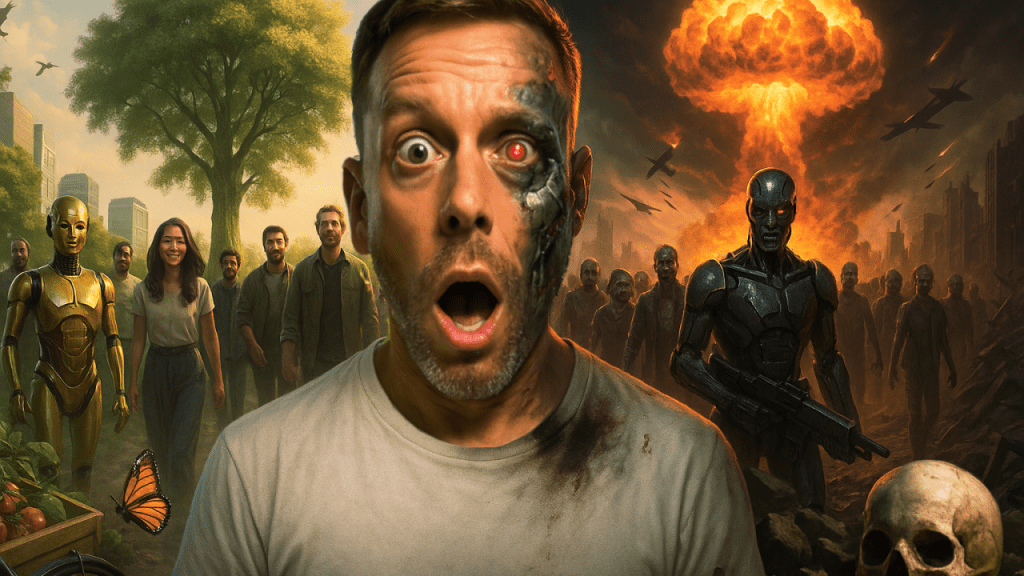
Because a world shaped by the Left’s AIs might be super chilled out but the one the Right’s AIs are currently building looks more like the lovechild of Terminator and The Matrix.
Written by Ben Kidd, with collaborative input from ChatGPT-4o.
*Note on language: Throughout this piece, I’ve used terms like “The Left” and “The Right” to describe broad tendencies, not rigid identities. These labels are increasingly inadequate to reflect the complexity of our political and social realities. I use them as shorthand to explore asymmetries in AI engagement, deployment, and influence. “The Left,” as it appears here, includes those who prioritise collective responsibility, caution around emerging power structures, empathy as a guiding value, and a deep appreciation for culture and the arts. “The Right” refers to groups or individuals who value speed, competition, individual advantage, and influence over system-wide checks, often downplaying or dismissing the societal value of creative work. When I use the word “we,” I mean those of us who value equity, creativity, shared responsibility, and the ethical shaping of technology, wherever we may fall on the ideological spectrum.

References
- Journal of Democracy. “How AI Threatens Democracy.” https://www.journalofdemocracy.org/articles/how-ai-threatens-democracy
- ScienceDirect. “Perceived Bias and Political Beliefs in AI-Generated Content.” https://www.sciencedirect.com/science/article/pii/S2949882124000689
- Atkinson, James. “The AI Cognitive Disengagement Spectrum.” LinkedIn. https://www.linkedin.com/pulse/ai-cognitive-disengagement-spectrum-understanding-shift-atkinson-btskc
- Mo Gawdat. Scary Smart: The Future of Artificial Intelligence and How You Can Save Our World. https://www.amazon.com/Scary-Smart-Future-Artificial-Intelligence/dp/1529077621
- Mohammad Amir Anwar. “Artificial Intelligence and the Hidden Global Workforce.” SSRN. https://papers.ssrn.com/sol3/papers.cfm?abstract_id=4997122


Leave a Reply