This article was originally published on LinkedIn, July 10th, 2025. Archived here for posterity and accessibility.
The historical development of the “policeman within”, meaning the internalisation of authority, discipline, and ideological conformity, offers critical context for analysing contemporary political measures such as the British Government’s proscription of Palestine Action as a so-called “terrorist organisation”.
Palestine Action is a UK-based direct action group founded in 2020 to disrupt and dismantle sites linked to the Israeli arms trade. The group has carried out high-profile actions including occupying factories, smashing windows, and painting facilities in red to symbolise bloodshed. In June 2025, activists sprayed paint into the engines of RAF transport aircraft at Brize Norton, reigniting national debate.
On 23 June 2025, UK Home Secretary Yvette Cooper laid a motion before Parliament to proscribe the group under the Terrorism Act 2000. The motion passed by 385 votes to 26. As a result, it is now a criminal offence, punishable by up to 14 years in prison, to support, fund, belong to, or display symbols associated with Palestine Action.
Within days, 29 arrests were made under terrorism laws, including university protestors, elderly clergy members and public supporters. UN human rights experts have warned that the move may be incompatible with international standards protecting freedom of expression and assembly. One official stated, “Non-violent civil disobedience and direct action do not amount to terrorism.” Legal experts and civil liberties groups echoed this concern, with one noting: “unless direct action advocates violence against civilians, labelling such protest groups as terrorist is absurd”.
UPDATE: One week later, 12/7/2025 a further 46 arrests of protestors supporting Palestine Action, were made in parliament square. https://www.independent.co.uk/news/uk/home-news/parliament-square-metropolitan-police-protesters-mahatma-gandhi-police-b2787866.html
Civil liberties organisations have drawn comparisons to historical crackdowns on protest movements in the UK. The 1974 Prevention of Terrorism Act was used to target Irish communities and political dissenters; in 2011 the Government discussed proscribing the non-violent international Occupy Movement. More recently, laws such as the Public Order Act 2023 have been criticised for criminalising Extinction Rebellion’s disruptive but peaceful protest. Liberty has described the proscription of Palestine Action as a “chilling escalation in the policing of dissent.”
When dissenting political movements are criminalised, the objective is rarely just containment. It is intended to reshape the Overton Window, the boundaries of acceptable thought and action. As Noam Chomsky puts it: “Strictly limit the spectrum of acceptable opinion, but allow very lively debate within that spectrum.”
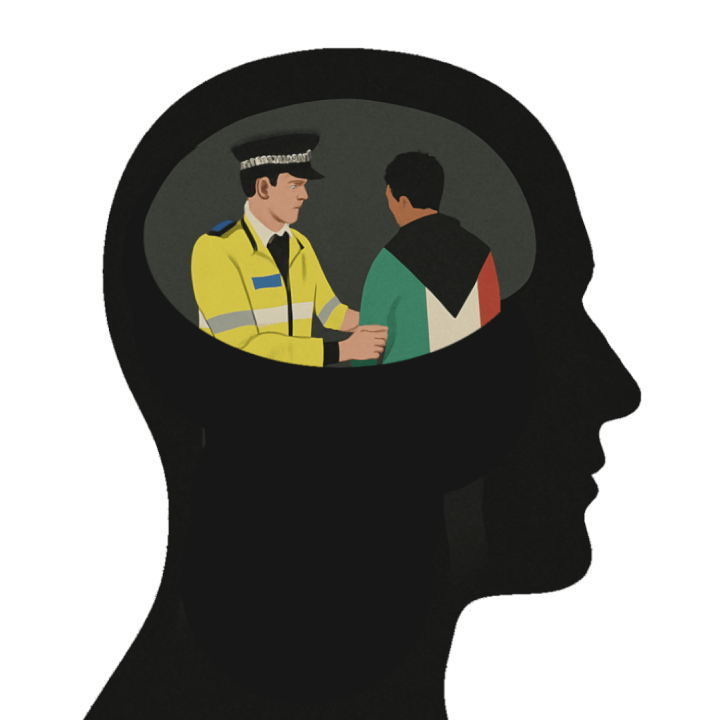
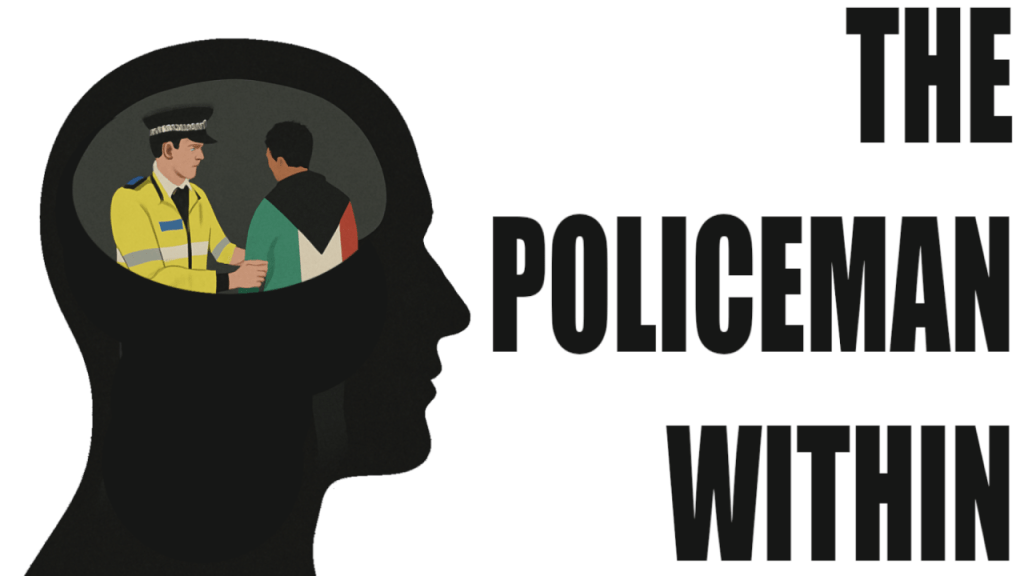
Proscription operates not only through police powers and public messaging, but through the cultivation of fear, complicity, and silence within the minds of observers, activists, and institutions alike. It empowers the policeman within.
Of course, there simply aren’t enough prison spaces in the country to incarcerate every individual who expresses support for Palestine Action for fourteen years, nor, one suspects, is that the true objective. The wave of over twenty arrests on 5 July, most of them in Parliament Square, appeared less about mass enforcement than about theatrical impact. These were not accidental infringements; activists had positioned themselves to be arrested under the new legislation, deliberately testing its limits and signalling defiance.

A National March for Palestine – Stop Starving Gaza is scheduled for 12-4pm Saturday 19 July. With arrests already made under the legislation and guidance issued to universities warning students against showing support, there is understandable concern over the conflation of support for the people of Palestine with support for the group Palestine Action. The stakes have risen sharply. The question now is not how many people the state can arrest, but how many it can convince to self-censor.
In essence, the government isn’t just executing arrests; it’s outsourcing compliance to the internal ‘policeman within.’

The following dataset traces how thinkers from St Paul to Shoshana Zuboff have documented the mechanisms through which power migrates inward, transforming external coercion into self-regulation.
Thinkers and Theorists on Internalised Mechanisms of Control
- St. Paul (1st c. CE, Epistles) Concept: Conscience as divine witness and moral regulator Quote: “Their conscience also bearing witness, and their thoughts the meanwhile accusing or else excusing one another.” — Romans 2:15
- St. Augustine (c. 400 CE, Confessions) Concept: God as internal observer; sin and guilt as inescapable Quote: “You were within me, but I was outside myself… and there I sought you.”
- Thomas Aquinas (c. 1274, Summa Theologica) Concept: Conscience as voice of divine law within Quote: “Conscience is the dictate of reason… by which we judge that something should be done or not done.”
- Immanuel Kant (1785, Groundwork of the Metaphysics of Morals) Concept: The moral law within as basis for internal duty Quote: “The starry heavens above me and the moral law within me.”
- Jeremy Bentham (1791, Panopticon Letters) Concept: Surveillance creates self-discipline through visibility Quote: “A new mode of obtaining power of mind over mind…”
- Max Stirner (1844, The Ego and Its Own) Concept: Ideological constructs as mental overlords (“spooks”) Quote: “They are my thoughts, which I fear, because they are not my own… but the church’s, the state’s, society’s…”
- Fyodor Dostoevsky (1866, Crime and Punishment) Concept: Conscience as punisher; guilt outstrips law Quote: “Crush me, judge, but let me confess!”
- Mikhail Bakunin (1871–76, God and the State) Concept: Rejection of ideological authority and imposition Quote: “I remain the eternal enemy of all imposed authority.”
- Sigmund Freud (1923, The Ego and the Id) Concept: The super-ego as harsh internal enforcer Quote: “The super-ego… rages against the ego with merciless violence.”
- Edward Bernays (1928, Propaganda) Concept: Mass manipulation creates internalised compliance Quote: “The intelligent manipulation of habits and opinions…”
- Paul Goodman (1945, The May Pamphlet) Concept: Conformity as betrayal of natural instinct Quote: “Treason of the clerks, cowardly taking leave of their hearts.”
- George Orwell (1949, Nineteen Eighty-Four) Concept: Thoughtcrime and self-surveillance Quote: “The Thought Police would get him just the same.”
- Frantz Fanon (1952, Black Skin, White Masks) Concept: Colonised minds internalise racist ideology Quote: “The oppressed will always believe the worst about themselves.”
- Jacques Lacan (1953–1977, various seminars) Concept: The super-ego as a sadistic internalised demand to enjoy and obey Quote: “The super-ego is not the law, but the law’s ferocity.”
- Herbert Marcuse (1964, One-Dimensional Man) Concept: Capitalism reshapes desire and identity Quote: “They find their soul in their automobile…”
- Marshall McLuhan (1967, The Medium is the Massage) Concept: Media normalises self-regulation Quote: “The policeman in our heads is now more real than the one on the street.”
- Guy Debord (1967, The Society of the Spectacle) Concept: Spectacle mediates human relations Quote: “A social relation among people, mediated by images.”
- Louis Althusser (1970, Ideological State Apparatuses) Concept: Ideology produces compliant subjects Quote: “Ideology represents the imaginary relationship…”
- Pierre Bourdieu (1972, Outline of a Theory of Practice) Concept: Habitus as internalised social structure Quote: “The most successful ideological effects are those which have no need for words.”
- Ion Mihai Pacepa (1978–84, Disinformation) Concept: Destabilisation through induced internal confusion Quote: “Disinformation is as powerful as tanks and missiles.”
- Michel de Certeau (1980, The Practice of Everyday Life) Concept: Creative subversion within imposed systems Quote: “The tactics of consumption… compose the network of an antidiscipline.”
- bell hooks (1981, Ain’t I a Woman) Concept: Internalised oppression in marginalised groups Quote: “It is internalized by the oppressed.”
- Angela Davis (1981, Women, Race & Class) Concept: Systems teach the oppressed to blame themselves Quote: “Those who have created and perpetuated that system… taught us to blame ourselves.”
- Noam Chomsky (1988, Manufacturing Consent) Concept: Media narrows the range of permitted thought Quote: “Strictly limit the spectrum of acceptable opinion…”
- Judith Butler (1990, Gender Trouble) Concept: Gender is a socially enforced performance Quote: “Gender identity is performatively constituted.”
- Terence McKenna (1992, Culture Is Not Your Friend) Concept: Culture implants limits on thought and action Quote: “Subliminal mechanisms of control… claiming your identity, then acting from that.”
- Naomi Klein (2007, The Shock Doctrine) Concept: Crisis and disaster regimes create psychological paralysis, promoting self-censorship and internalised obedience Quote: “This is the truly insidious nature of self‑censorship: it does the gag work more efficiently than an army of bullying and meddling media moguls could ever hope to accomplish.”
- Patricia Hill Collins (2000, Black Feminist Thought) Concept: “Controlling images” internalised by Black women reinforce subordination Quote: “The power of self-definition is one of the most significant forms of resistance.”
- Silvia Federici (2004, Caliban and the Witch) Concept: Capitalism and patriarchy enforce discipline through gendered and bodily control Quote: “The body has been for women in capitalist society what the factory was for male waged workers.”
- Jaron Lanier (2010, You Are Not a Gadget) Concept: Platform logic manipulates identity and volition from within Quote: “You have to be somebody before you can share yourself.”
- David Graeber (2015, The Utopia of Rules) Concept: Bureaucracy instils obedience and internalised deference to rules Quote: “Bureaucracies public and private appear… as forms of utopian fantasy that do not so much restrict imagination as attempt to shape it.”
- Byung-Chul Han (2015, The Burnout Society) Concept: Neoliberal self-optimisation creates internalised overproduction and self-blame Quote: “The complaint of the depressive individual, ‘Nothing is possible,’ can only occur in a society that thinks, ‘Nothing is impossible.’”
- Shoshana Zuboff (2019, The Age of Surveillance Capitalism) Concept: Behavioural data exploitation leads to self-censorship Quote: “Now they know everything about us. We know nothing about them.


Leave a Reply